
The true price of a home extension isn’t found in the bricks and mortar alone, but in the paperwork that validates every structural choice you make. Whilst many homeowners focus on the aesthetic of a new wrap-around extension, the building regulations certificate cost uk remains a critical, yet often misunderstood, line item in any project budget. It’s the difference between a legally sound investment and a structural headache that could stall a future property sale.
We understand that the distinction between planning permission and building control can feel like a labyrinth of bureaucracy, especially when you’re eager to see your vision take shape. You want clarity, not a surprise bill from the council halfway through your build. This guide provides a definitive breakdown of what you’ll actually pay in 2026, from standard application fees for loft conversions to the 150% surcharge often applied to retrospective regularisation. You’ll discover how to navigate the choice between local authority inspectors and private approved inspectors, whilst seeing how professional Building Regulations Services can streamline your path to a completion certificate in London.
Key Takeaways
- Master the three-part fee structure to accurately forecast your building regulations certificate cost uk, ensuring you budget correctly for both plan checks and site inspections.
- Recognise the vital difference between planning permission and building control to ensure your project meets technical safety standards without legal delays.
- Avoid the financial sting of regularisation fees by securing approval before you build, saving you from retrospective surcharges that can significantly inflate your budget.
- Discover how specialist partners streamline the certification process, using precise structural planning to eliminate the risk of expensive re-inspections.
- Identify the supplementary costs of compliance, such as structural engineer calculations and energy assessments, which are essential for complex urban extensions.
Understanding the Building Regulations Certificate and its Financial Impact
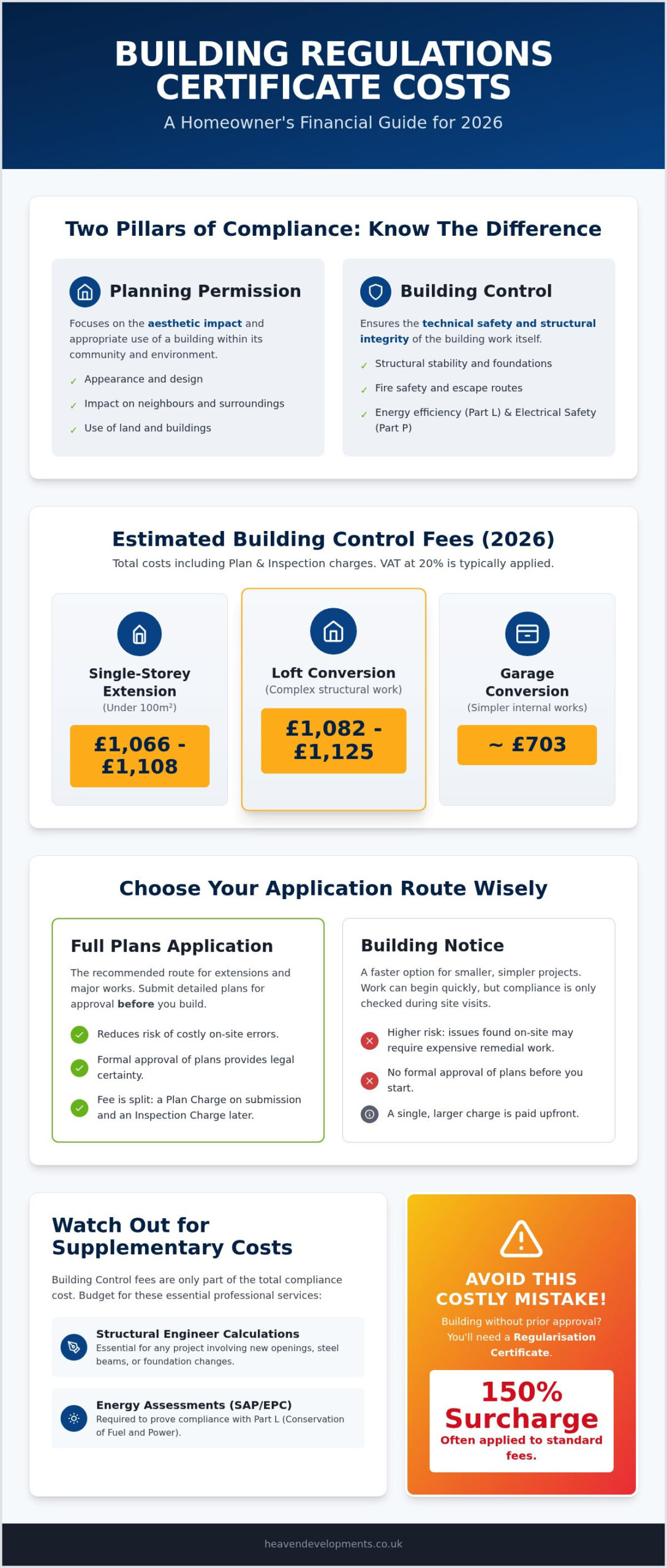
Think of the building regulations certificate as your project’s final exam. It serves as the definitive proof that your new loft extension or wrap-around extension isn’t just visually stunning, but structurally sound and safe for habitation. This document is distinct from planning permission. Whilst planning permission focuses on the aesthetic impact and usage of a building within its community, building control is purely technical. It ensures your home meets the rigorous standards set out in the UK Building Regulations overview, covering everything from foundations to fire escapes.
Different “Parts” of the regulations dictate the technical requirements your builder must meet. For instance, Part L focuses on the conservation of fuel and power, whilst Part P governs electrical safety. These technical demands directly influence the total building regulations certificate cost uk because more complex requirements often necessitate more frequent inspections or specialist reports from structural engineers. Ensuring compliance from day one prevents the need for costly remedial work later.
The Legal Necessity of Compliance
If you decide to sell your home, a missing completion certificate acts as a significant red flag. Solicitors will demand this proof during the conveyancing process. Without it, prospective buyers may struggle to secure a mortgage, and you might be forced to lower your asking price or pay for expensive indemnity insurance. The Building Safety Act 2022 has further tightened these rules, placing greater accountability on homeowners and developers to ensure every stage of construction is signed off correctly. The building regulations completion certificate is the gold standard for structural legality and provides peace of mind for both current owners and future buyers.
Who Issues the Certificate?
You have two main paths for certification: Local Authority Building Control (LABC) or private Approved Inspectors. While your local council provides a traditional service, many London homeowners opting for complex projects favour private inspectors. These professionals often offer a more collaborative approach and faster response times, which can be vital when coordinating multiple trades on a tight schedule. Your choice of provider will affect the overall building regulations certificate cost uk, as private firms set their own commercial rates whilst local authorities typically follow fixed fee scales based on the project’s valuation or floor area.
Breakdown of Building Regulations Application Fees
Understanding the building regulations certificate cost uk requires looking past a single figure. Most providers, whether local councils or private firms, operate a tiered fee structure based on the complexity and scale of the work. For domestic projects, you’ll typically encounter a three-part system: the Plan Charge, paid upon submission; the Inspection Charge, invoiced after the first site visit; or a single Building Notice Charge. Since April 2026, many authorities have adjusted these rates to reflect rising operational costs, with VAT at 20% almost always applied to domestic residential fees.
Full Plans Application vs. Building Notice
Choosing between a Full Plans application and a Building Notice is a strategic decision. A Full Plans submission involves providing detailed architectural drawings before any ground is broken. This is the gold standard for extensions because it allows the inspector to flag issues on paper rather than in the foundation trench. Conversely, a Building Notice is faster, often used for smaller internal works. It carries a higher risk, as you won’t receive a formal approval of plans. If the work doesn’t meet The Building Regulations 2010 during a site visit, you might face expensive remedial costs that far outweigh any initial saving.
Estimated Fees by Project Type
In 2026, the scale of your project directly dictates your fee tier. For a standard single-storey extension under 100m², you should budget between £1,066 and £1,108 for the total building control fee. Loft conversions are slightly more complex due to fire safety and structural reinforcement, with total fees often ranging from £1,082 to £1,125. Smaller works like garage conversions typically sit around the £703 mark. These figures represent the baseline for compliance, but they can fluctuate depending on whether you choose a local authority or a private inspector.
Larger projects, such as a wrap-around extension, may require bespoke quotes if the floor area exceeds 100m². By engaging with specialists who provide comprehensive Building Regulations Services, you can ensure your application is accurate the first time. This proactive approach helps you avoid the costly re-submission fees that often catch homeowners off guard. Accurate initial drawings don’t just save time; they protect your budget from the hidden costs of non-compliance.
Factors Influencing the Total Cost of Compliance in 2026
The base application fee is rarely the final figure on your compliance balance sheet. When budgeting for your building regulations certificate cost uk, you must account for the bespoke technical requirements that arise from your home’s unique footprint. In London and surrounding areas, project complexity often dictates a higher frequency of site inspections. A simple rear house extension might require four or five visits, whereas a large extension project creating open plan living necessitates additional oversight to verify the installation of substantial structural steels and the integrity of newly created spans.
Geographic location remains a primary driver of the building regulations certificate cost uk. London authorities often charge a premium to reflect the administrative intensity of urban construction and the intricate nature of managing sites with limited access or shared party walls. Beyond the council’s fee, the total cost of compliance is frequently influenced by the need for supplementary professional documentation that proves your design meets national safety standards.
The Role of Structural Engineers
A building control inspector cannot issue a final certificate based on visual evidence alone. They require verified structural calculations to prove that your new floor joists or steel beams can support the intended loads. For homeowners undertaking loft conversions, these reports are non-negotiable. In London, you should budget between £500 and £1,500 for a structural engineer’s report, depending on the complexity of the steelwork required. This investment ensures that your visionary design is backed by technical precision, preventing structural failure and ensuring a smooth sign-off during the final inspection phase.
Energy Efficiency and SAP Ratings
The 2026 updates to Part L of the building regulations have introduced even more stringent requirements for thermal performance and carbon reduction. For new builds and significant extensions, a Standard Assessment Procedure (SAP) calculation is often required to demonstrate that the building’s energy footprint falls within legal limits. This process involves a detailed analysis of your insulation, glazing, and heating systems.
Whilst these assessments and the subsequent pressure testing add an extra layer of initial expense, they serve a vital purpose. They ensure your home is future-proofed against rising energy costs. By investing in high-performance materials early in the journey, you aren’t just meeting a regulatory hurdle; you’re creating a sustainable, high-value asset that remains efficient for decades to come. This proactive approach to energy compliance is a hallmark of a well-managed project.
Navigating Hidden Charges and Regularisation Fees
The most significant threat to your project budget isn’t the standard application fee, but the punitive costs associated with retrospective approval. If you’ve already commenced work or purchased a property with unauthorised alterations, you’ll need to apply for a Regularisation Certificate. This process is designed to bring illegal works into compliance, but it carries a heavy financial burden. In 2026, the building regulations certificate cost uk for regularisation is typically calculated as the standard building notice fee plus a surcharge that often ranges from 25% to 50%. In some jurisdictions, the total regularisation fee can be as high as 150% of the standard rate, reflecting the additional administrative work required to verify hidden structures.
Beyond the paperwork, the physical cost of inspection can be devastating. Because an inspector cannot sign off on what they cannot see, you may be required to “open up” completed work. This might involve hacking off plaster to reveal lintels, digging trial pits to expose foundations, or removing ceiling sections to check floor joists. The expense of these invasive checks, coupled with the subsequent repair work, often dwarfs the original cost of a proactive application. When you inherit a property without the necessary sign-off, these hidden charges become a mandatory hurdle before any future sale can proceed.
The Risks of Unauthorised Construction
Skipping the formal building control process is a false economy that creates long term legal vulnerabilities. Local authorities have the power to issue enforcement notices for non-compliant work, which can lead to prosecution or a mandatory requirement to demolish unsafe structures. This isn’t just about safety; it’s about protecting your equity. Regularisation is always more expensive than proactive compliance. By bypassing the rules, you risk devaluing your home and incurring massive legal fees when a solicitor eventually flags the missing paperwork during a property transaction.
Additional Inspection Charges
Your initial fee usually covers a set number of site visits. However, if your contractor fails to meet standards during a specific phase, you may be charged for supplementary inspections to verify that remedial work has been completed correctly. Similarly, if you decide to alter your build plans midway through the project, you’ll likely face additional administrative charges to revise your approved drawings. Managing the technical paperwork for building regulations for house extensions requires precision to avoid these avoidable re-inspection costs.
To secure your project’s legality without the stress of hidden surcharges, you can partner with our experts for professional Building Regulations Services that ensure compliance from the very first brick.
How a Professional Build Partner Minimises Regulatory Costs
Managing the building regulations certificate cost uk is often more about efficiency than finding the lowest application fee. A professional partner acts as a visionary guide, ensuring that every structural detail is aligned with current legislation before the first inspector arrives on site. This proactive management prevents the expensive cycle of failed inspections and plan revisions that often plague self-managed projects. By integrating the technical gravity of construction with a collaborative spirit, a design and build firm transforms a complex legal hurdle into a seamless part of your home’s creative journey.
Accurate initial drawings are the foundation of a cost-effective build. When architectural plans are developed in tandem with structural engineering calculations, the risk of “opening up” work or facing mid-build enforcement notices is virtually eliminated. This unified approach streamlines the workflow between your structural engineer and the building control officer, ensuring that technical queries are resolved in hours rather than weeks. It’s about creating a methodical progression that builds trust with the authorities, ultimately protecting your budget from the hidden surcharges that can arise during unauthorised or poorly planned construction.
Integrated Technical Support
At Heaven Developments, we provide comprehensive Building Regulations Services as part of our end-to-end project management. This professional oversight is particularly vital for complex wrap around extensions where structural integrity and fire safety requirements are at their most demanding. Our specialists understand the London-specific nuances of building control, ensuring that your vision isn’t just beautiful, but fully compliant with the latest 2026 standards. This reduces the likelihood of expensive remedial works, keeping your project on track and within its original financial framework.
From Planning to Completion
Securing your final completion certificate should be a moment of celebration, not a bureaucratic struggle. We manage the entire lifecycle of your project to ensure a smooth transition from the initial spark of an idea to the final sign-off. Our process ensures your certificate is issued promptly through a structured approach:
- Submitting detailed Full Plans to minimise the risk of non-compliance during the build phase.
- Coordinating all mandatory site inspections at critical milestones, such as foundation pouring and structural steel installation.
- Compiling all necessary specialist documentation, including Part P electrical and Part L energy reports.
- Conducting a final pre-inspection check to ensure every detail meets the inspector’s high standards before the official visit.
The result is a fully compliant, high-quality residential project that carries its full market value. You can move forward with total peace of mind, knowing your investment is legally secure and built to last. Enquire about your compliant home extension today and let our team manage the technical complexities for you.
Investing in a Seamless Path to Completion
Navigating the technical landscape of building control doesn’t have to be a source of project anxiety. By understanding the building regulations certificate cost uk, you’ve already taken the first step towards a transparent and well-managed budget. Remember that the true value of your home extension lies in its legality and structural integrity. Avoiding the punitive surcharges of retrospective regularisation ensures your investment remains protected from the moment work begins.
A successful project thrives on the synergy between visionary design and precise technical execution. With over 20 years of London construction expertise, our team specialises in high-end residential refurbishments that meet every regulatory standard without compromising on aesthetic goals. We provide full management of both planning and building regulations, allowing you to focus on the excitement of your new space whilst we handle the intricacies of compliance.
Secure your compliant home extension with Heaven Developments and transform your architectural aspirations into a legally sound reality. Your dream home deserves a foundation of absolute certainty.
Frequently Asked Questions
Is a building regulations certificate the same as a completion certificate?
Yes, the completion certificate is the formal building regulations certificate issued at the end of a project. It confirms that the works comply with the technical standards for safety and energy efficiency. While people often use the terms interchangeably, the completion certificate is the specific legal document you’ll need to provide to solicitors during a property sale to prove the work was inspected and approved by building control.
How much does a building regulations certificate cost for a small extension?
For a small single-storey extension under 100m², you should budget approximately £1,066 to £1,108 for the total building regulations certificate cost uk in 2026. This fee typically includes both the plan check and the necessary site inspections. Keep in mind that costs can vary between local authorities and private approved inspectors, particularly for bespoke projects in London that require additional structural oversight or more frequent site visits.
Can I sell my house without a building regulations completion certificate?
You can technically sell a house without a completion certificate, but it often causes significant delays or price devaluations. Most buyers’ solicitors will identify the missing paperwork during the conveyancing process. To proceed, you might be required to purchase indemnity insurance or apply for retrospective regularisation, which can be far more expensive and time-consuming than securing the certificate during the initial construction phase through a standard application.
How long is a building regulations certificate valid for?
A building regulations completion certificate remains valid indefinitely once issued as it proves the work met standards at the time of construction. However, if you’ve submitted an application but haven’t started work, the approval usually lapses after three years. It’s vital to ensure your builder notifies building control at the start and end of the project to ensure the final document is actually triggered, signed off, and archived correctly.
Do I pay building control fees to the council or my builder?
You usually pay building control fees directly to the local authority or the private approved inspector you’ve chosen. While some builders include these as disbursements within their overall quote, the legal responsibility for payment rests with the property owner. Paying the inspector directly ensures you have a clear paper trail and direct communication regarding the status of your final building regulations certificate cost uk and all mandatory site inspections.
What happens if building control refuses to issue a certificate?
If building control refuses to issue a certificate, it’s usually because the work fails to meet specific safety or structural standards. You’ll be given a list of remedial actions required to bring the build into compliance. You must complete these corrections and arrange a re-inspection. If you fail to rectify the issues, the council can issue an enforcement notice requiring you to alter or even remove the non-compliant work entirely.
Are building regulations fees refundable if I cancel the project?
Building regulations fees are generally non-refundable once the council or inspector has started the plan-checking process. If you cancel the project before any drawings have been reviewed, you might receive a partial refund of the plan charge. However, the inspection charge is typically only billed or retained if site visits have actually commenced. It’s best to check the specific terms of your chosen local authority or private inspector before paying.
How much extra does regularisation cost compared to a standard application?
Regularisation is significantly more expensive, often carrying a surcharge of 25% to 50% above the standard building notice fee. In many cases, the total cost for retrospective approval can reach 150% of the standard rate. This punitive pricing reflects the extra administrative effort required to inspect work that’s already been covered up, often requiring you to expose foundations or structural steels at your own additional expense to satisfy the inspector.